
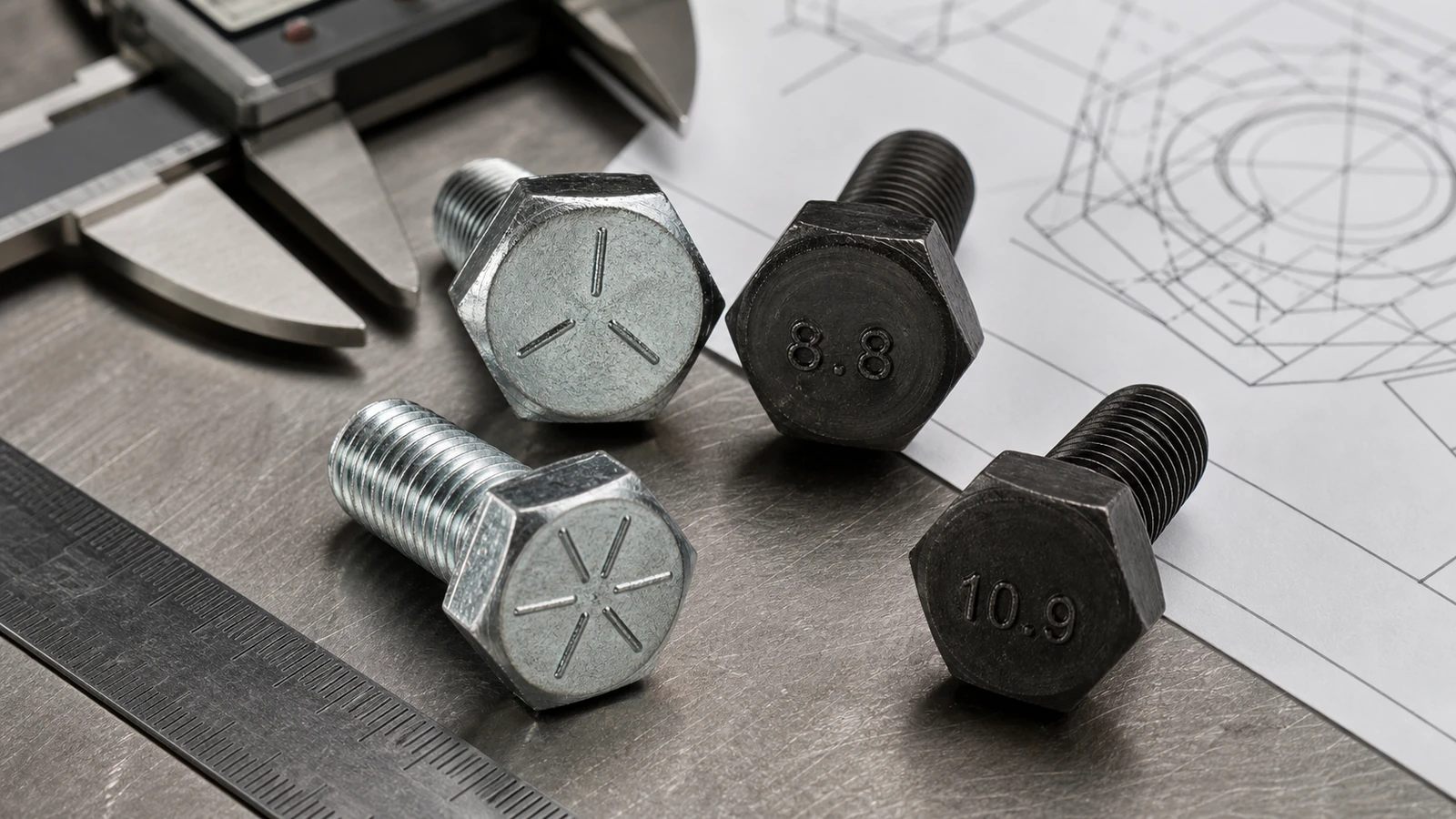
A bolt grade chart looks simple until it gets copied into the wrong context. Buyers see a head marking, match it to a chart, and assume the job is finished. In reality, the chart is only a starting clue. The real decision still depends on whether the part is inch or metric, which standard governs it, what size range the rating applies to, and whether coating, lubrication, or joint type changes the usable torque and preload.
This guide shows how to read a bolt grade chart for OEM RFQs without mixing grading systems or approving the wrong fastener family at incoming inspection.
What a bolt grade chart tells you and what it does not
A bolt grade chart helps identify common strength classes and head markings. Practical references such as Bolt Depot and Portland Bolt map markings to mechanical ranges, while formal systems come from governing standards. Official references underline the same principle. ISO explains that the 898 series defines property classes for bolts, screws, and studs, and ASTM states that structural bolts are designated by grade and type within their own specifications.
What the chart does not do is prove interchangeability. A head marking cannot tell you by itself whether the part is a structural heavy-hex bolt, a general-purpose cap screw, a plated commercial fastener, or a special product outside the size range shown on a popular web graphic. The chart must always be paired with the actual standard or drawing requirement.
Keep SAE grade, ASTM specification, and ISO property class separate
Many RFQ errors come from mixing naming systems that happen to look comparable. In inch hardware, buyers often talk about SAE Grade 2, Grade 5, or Grade 8 markings. In metric hardware, they may see property classes such as 8.8, 10.9, or 12.9. Structural fasteners can also be called out by ASTM specifications and types. These are not interchangeable labels, even when some strength values appear similar in a chart.
The safest workflow is to identify the measurement system first, then read the drawing or product standard that applies to that family. If the engineer wants a metric socket screw, the property class belongs to the metric standard path. If the engineer wants a structural heavy-hex bolt, the ASTM path matters. If the buyer only sees a shop-floor head marking and no standard, the correct response is clarification, not substitution.
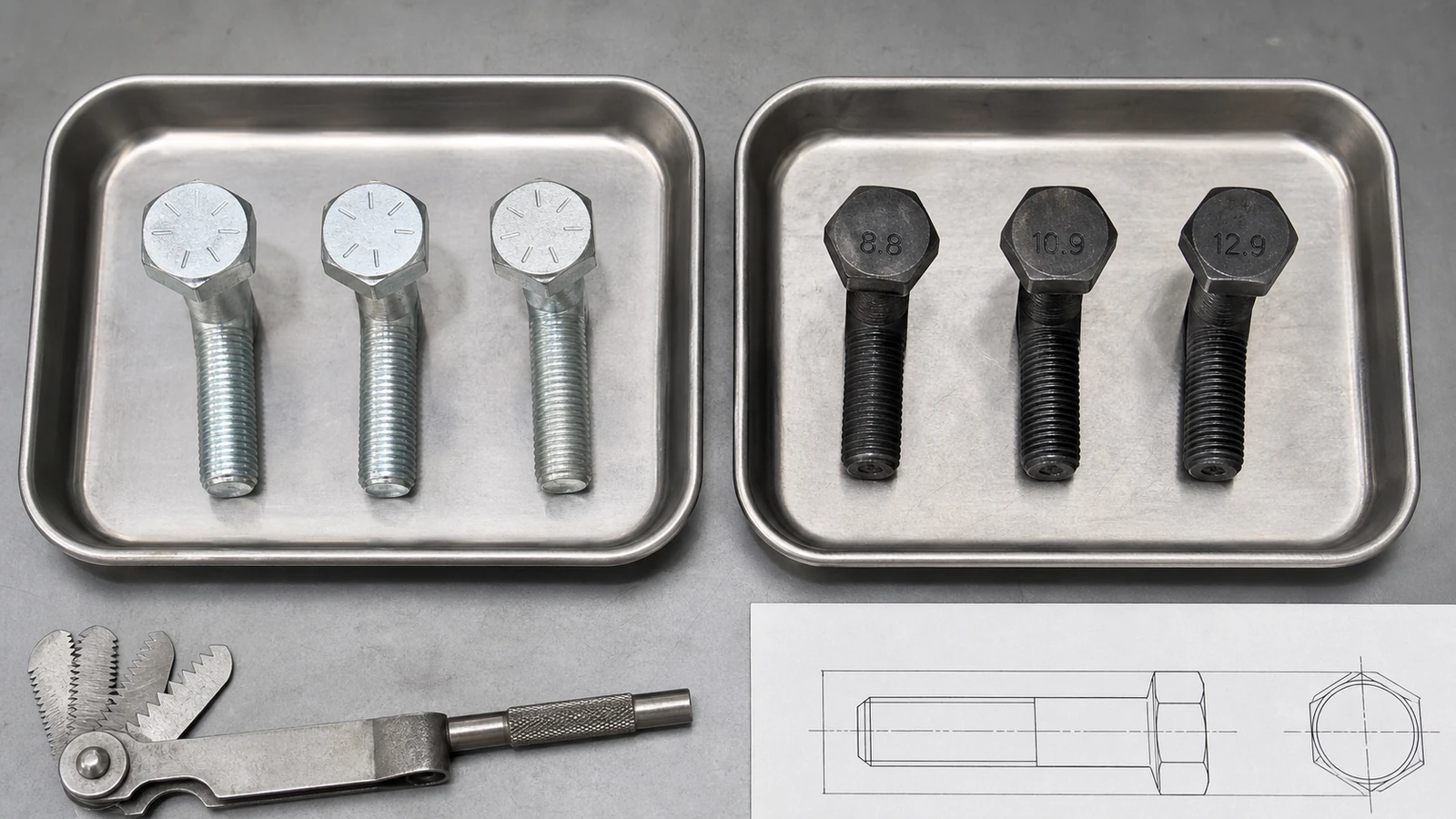
Head markings are useful, but only after you confirm the product family
Charts are helpful because head markings give a quick visual clue. But even strong charts warn that manufacturers may also stamp identification marks and that markings vary by family. That is why incoming inspection should not stop at counting radial lines or reading one number on the head. You still need to verify the diameter range, thread form, head style, finish, and any required mill or test documents.
For example, a buyer might see a high-strength-looking mark on a part that is dimensionally wrong for the joint, coated differently from the approved sample, or sourced from a product family with different proof and hardness requirements. The mark is part of identification, not the entire approval process.
- Use head markings to narrow the candidate, then confirm the governing standard.
- Check whether the grade or property class shown applies to the actual diameter range you are buying.
- Review manufacturer identification marks separately from grade marks.
- Do not approve a substitute only because the head marking appears stronger on a generic chart.
Torque and preload cannot be copied blindly from a chart
Another common failure is taking a chart value and turning it into a production torque without checking finish and joint condition. NASA’s Fastener Design Manual and other engineering references repeatedly show that fastener behavior changes with lubrication, plating, friction, and joint design. A plated or lubricated fastener can produce more preload at the same torque than an uncoated part, so a shop chart copied from a dry condition can overtighten the joint.
That matters in OEM purchasing because the same nominal grade may arrive with different coatings, waxes, patch materials, or anti-seize instructions depending on the supplier and application. A bolt grade chart is therefore not a universal torque card. It is a classification aid that still needs a joint-specific installation rule.
How to use a bolt grade chart in RFQ and incoming inspection
In an RFQ, the chart should help you write better questions. It should not replace the callout. If the design team references grade without identifying the standard, request clarification before ordering. If the grade is clear, record the inspection method that will be used at receiving: head marking, certificate review, dimensional checks, finish verification, and any mechanical test documents required by the program.
For incoming inspection, keep the chart at the desk but keep the standard in the file. The chart helps the inspector spot an obvious mismatch fast. The standard and purchase documents determine whether the lot is actually acceptable.
- Confirm inch vs metric system before approving any grade chart in the sourcing pack.
- Write the governing standard or property-class callout directly onto the RFQ or drawing note.
- Verify coating and lubrication condition before reusing torque references from prior lots.
- Match nuts, washers, and mating parts to the intended strength and joint style.
- Keep head-marking photos or sample boards in receiving, but do not treat them as a substitute for the specification.
Common mistakes that cost buyers time
The first mistake is assuming a stronger-looking grade is always a safe substitute. It may not match ductility, nut pairing, head geometry, or the approved torque window. The second is mixing metric property classes with inch-grade language in one drawing package. The third is relying on a retail or workshop chart that omits coating and size-range caveats.
Another expensive mistake is using a structural-bolt chart to source a precision machine fastener or vice versa. The joint may need a different head style, tolerance band, or surface condition than the popular chart suggests. The closer the part gets to a controlled OEM assembly, the less useful casual interchange becomes.
If your team is preparing a custom fastener program, XiYu Precision can review the requirement through the RFQ contact page, compare relevant product families in the custom screw catalog, and support drawing-based manufacturing review before sampling. The most valuable step is to resolve the governing standard early so the chart is used as a check, not as the specification itself.
Frequently asked questions
Is a bolt grade chart enough to identify a fastener for purchasing?
No. It helps identify likely strength class or head marking, but purchasing still needs the governing standard, size range, finish, thread form, and any required test or certificate documents.
Can SAE Grade 8 be treated as the same thing as metric 10.9 or 12.9?
Not automatically. Different grading systems belong to different standards and product families. Similar-looking strength ranges do not make them interchangeable without a formal engineering review.
Why can torque values change for the same grade?
Because torque is affected by lubrication, plating, friction, and joint design. A chart classifies the fastener, but the actual installation rule still has to follow the real joint condition.
What should incoming inspection check besides the head marking?
Check the drawing or purchase standard, diameter and thread details, finish, manufacturer documents, and any lot-specific mechanical requirements. The marking alone is not enough for acceptance.
Use the chart as a checkpoint, not as the final specification
A bolt grade chart is valuable because it speeds up recognition, but it becomes dangerous when it replaces the actual standard. The correct workflow is simple: identify the system, confirm the governing specification, then verify finish, size range, and joint conditions before release or receipt. That discipline keeps grade charts useful instead of misleading.