A button head screw is often chosen late in a design because its low, rounded profile looks unobtrusive. That shortcut can create a production problem. The broad head may interfere with a nearby wall, the shallow internal socket may limit usable installation torque, or the bearing surface may mark a cosmetic panel. The correct choice depends on the complete joint, not the head name alone.
This guide explains how to evaluate button head screws for compact equipment, covers the distinction between common product names, and identifies the drawing details a precision fastener supplier needs before quoting a standard or custom part.
What defines a button head screw
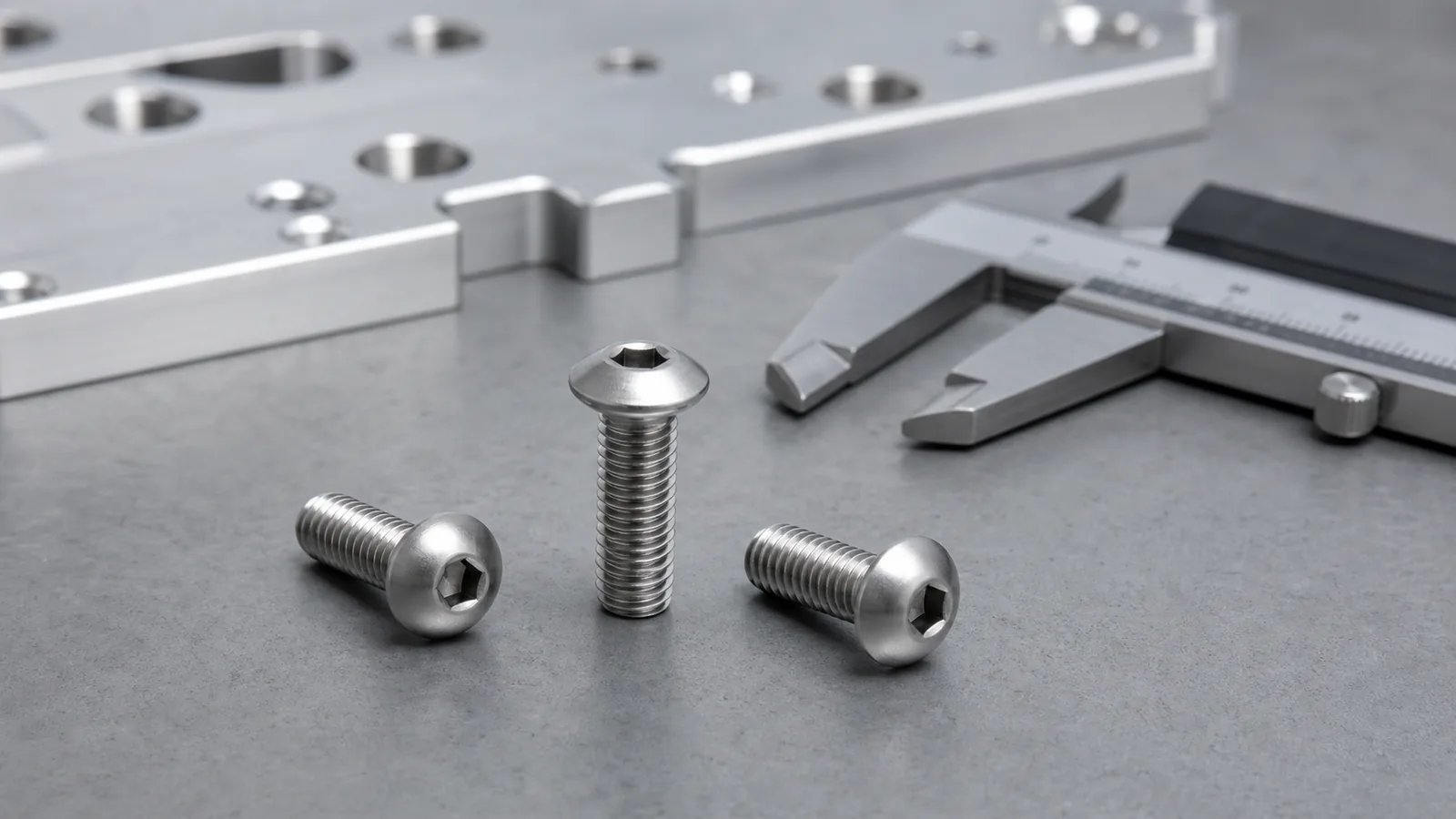
A button head screw combines a low domed top with a relatively wide head diameter and an internal drive, commonly a hex socket. The shape reduces projection above the assembly compared with a standard cylindrical socket head. It also spreads contact over a larger footprint than many small high-profile heads. Those two benefits explain its use in enclosures, guards, fixtures, furniture hardware, controls, and visible machine surfaces.
Product terminology is inconsistent. Buyers may search for button head cap screw, button head bolt, button head socket cap screw, or simply button head screw. These phrases can point to the same general geometry, but they do not define thread system, material, strength, drive size, head dimensions, or standard. A purchase description should therefore identify the applicable drawing or standard instead of relying on the noun bolt or screw.
Choose the head only after checking clearance and load
The first engineering check is the installed envelope. Measure allowable head height, head diameter, edge distance, tool approach, and clearance to moving components. A button head can solve a height conflict yet create a radial conflict because its dome is wider. In a narrow channel, the driver may reach the recess while the head still contacts a fillet or raised feature before it seats.
The broad underside can be useful on a slotted bracket or relatively soft cover, but it is not automatically a substitute for a washer. Bearing pressure still depends on clamp load, surface hardness, hole size, flatness, and the actual bearing geometry. If the mating panel is thin, painted, molded, or cosmetically critical, test for embedment, coating damage, dish formation, and relaxation after assembly.
- Confirm the maximum permitted head projection after seating, including coating buildup and part tolerance.
- Check that the full bearing surface lands on a flat area rather than a chamfer, radius, slot edge, or molded draft.
- Allow room for the driver body, not only the nominal bit, when the screw sits near a wall or inside a recess.
- Specify whether the dome is a visible surface and define acceptable tool marks, flow lines, scratches, or plating variation.
Understand the drive and tightening limitation
A low head leaves less vertical space for the internal recess than a standard socket head. That does not make every button head weak, but it does mean the drive cannot be treated as unlimited. Recess depth, across-corners geometry, material condition, bit fit, driver alignment, speed, and required clamp load determine whether the head can be installed without rounding or cracking.
Use the tightening values and strength limits associated with the selected fastener specification, then validate the joint. Do not transfer the torque used for a taller socket head screw of the same thread size. If the joint requires high preload, repeated service, or a small drive in a hard-to-reach location, a different head style may provide more margin. For production, use controlled drivers and replace worn bits before they begin to damage recesses.
Button head versus socket head and countersunk screws
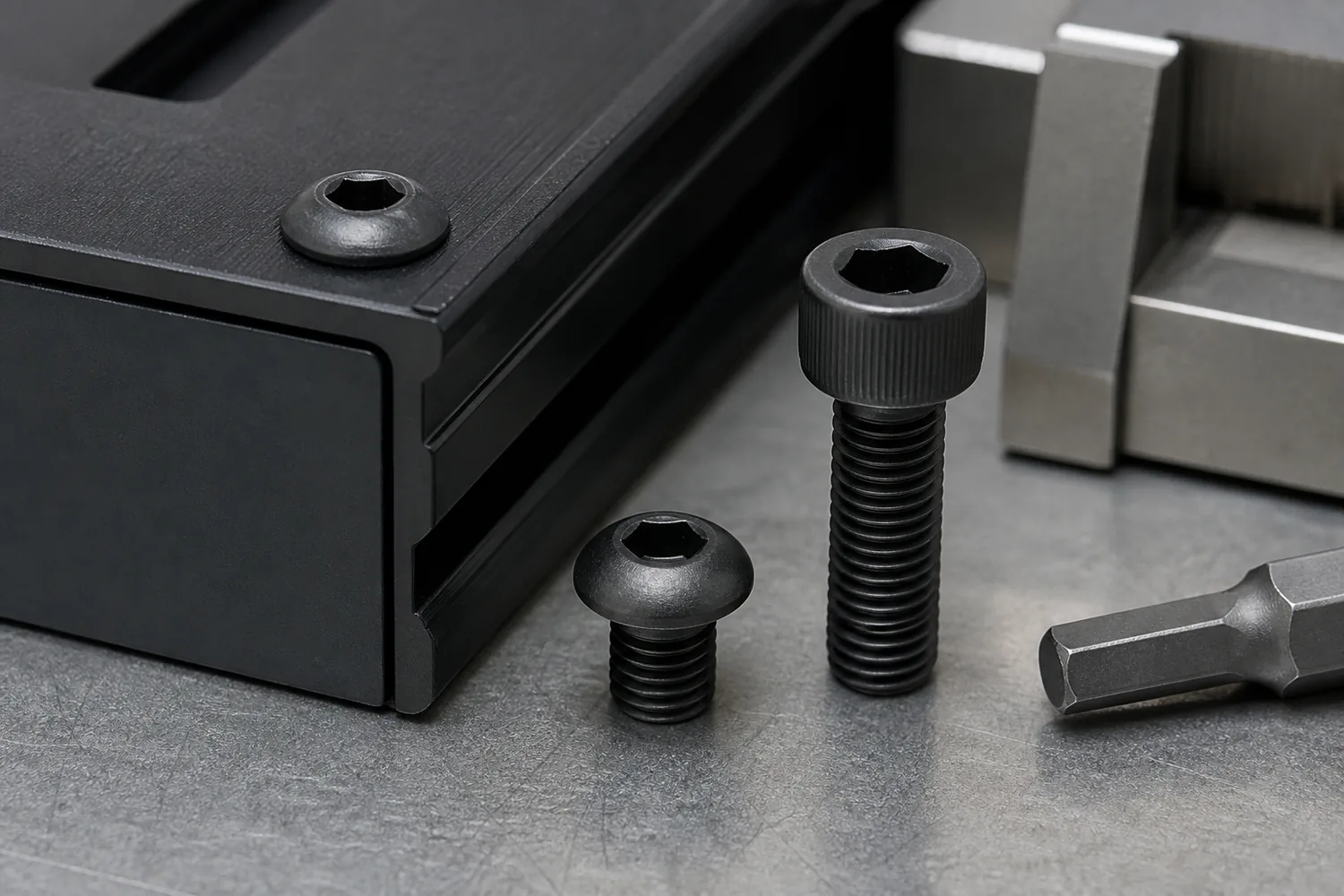
A standard socket head cap screw is usually the better starting point when drive engagement and high clamp load matter more than projection. Its taller cylindrical head provides room for a deeper internal socket, although it stands farther above the surface and may look too industrial for a visible panel.
A countersunk screw can sit flush, but it requires a controlled countersink and introduces a conical seating interface. Hole angle, depth, runout, panel thickness, and coating all affect final flushness. It may also generate radial forces in brittle or thin mating parts. A button head avoids the countersink operation and gives a smooth profile, but it remains proud of the surface.
The practical selection is therefore based on the failure you need to avoid. Choose a socket head for installation margin, a countersunk head for a truly flush surface when the joint supports it, or a button head when low projection, broad bearing, and a finished appearance are the priorities. Prototype the actual joint when two of these goals conflict.
Material and finish decisions belong to the joint specification
Carbon or alloy steel can provide high strength and economical cold forming, while stainless steel is often selected for corrosion exposure or appearance. Brass, aluminum, and other materials serve narrower electrical, weight, or decorative requirements. Material names alone are insufficient: specify the required property class or mechanical performance, corrosion environment, finish, and any restrictions on magnetism, substances, or color.
Finish thickness matters on threads and in the drive recess. Heavy or inconsistent coating can affect gauge fit, bit engagement, and assembly friction. Black oxide offers a dark appearance but should not be assumed to provide the same corrosion protection as an engineered plated or coated system. Stainless steel avoids a separate decorative coating in many applications, yet its installation behavior and galling risk still require review.
When a custom button head is justified
A custom part is justified when the standard head envelope, drive, thread length, point, material, or finish cannot satisfy the assembly. Typical requests include a reduced head diameter for a narrow pocket, a controlled dome for appearance, a nonstandard shoulder, a captive feature, a security drive, or a thread length tailored to avoid bottoming.
Every customization changes manufacturability. A very shallow head may leave inadequate recess depth. A sharp cosmetic edge can conflict with cold-heading flow or plating coverage. A large diameter may require more forming stages, a different blank size, or machining rather than straightforward cold heading. The supplier should review the drawing before the design is frozen, especially for small screws where small dimensional changes consume a large share of the available material.
Inspection points that prevent assembly surprises
Inspection should cover the features that control seating and tool engagement, not only thread size. Head diameter and height establish the envelope. Bearing surface flatness and perpendicularity influence seating. Recess size, depth, concentricity, and fill affect bit engagement. Thread gauges confirm functional fit, while length, point, material, hardness, and coating checks address the rest of the specification.
For a cosmetic part, agree on lighting, viewing distance, master samples, and permissible marks. For an automated line, run trial lots through the real feeder, bit, driver, and fixture. A dimensionally acceptable screw can still feed poorly or produce unstable torque if the head shape, surface finish, or recess condition varies within a range the assembly process cannot tolerate.
What to include in a button head screw RFQ
A complete RFQ lets the manufacturer distinguish a standard sourcing request from a precision custom program. Send a drawing or 3D model together with the assembly conditions. If only a sample exists, identify the dimensions and functions that must be preserved instead of asking the supplier to copy every incidental feature.
- Thread system, nominal size, pitch, tolerance, length definition, and required thread length.
- Head diameter, head height, dome profile, bearing geometry, and installed clearance limits.
- Drive type and size, permitted recess depth, tool access, target torque, and service cycles.
- Material, mechanical property requirement, finish, corrosion test, appearance, and compliance needs.
- Mating-part material, hole geometry, clamp requirement, quantity, packaging, and inspection documents.
XiYu Precision reviews drawing-based custom precision fastener requirements. You can compare related products in the custom screw catalog, review factory capabilities, and send the joint drawing through the RFQ contact page. Applications with critical preload or safety consequences require engineering validation by the joint designer.
Frequently asked questions
Are button head bolts and button head screws different?
The terms are often used interchangeably in catalogs. The name alone does not establish dimensions or performance. Use the applicable standard or drawing, thread specification, material, property requirement, drive, and finish to identify the part.
Can a button head screw take the same torque as a socket head cap screw?
Do not assume so. A button head usually has a shallower internal drive and may have different loadability under its governing specification. Use the selected product data and validate torque in the actual joint.
Does a button head eliminate the need for a washer?
Not automatically. Its wider bearing surface may help distribute load, but panel hardness, hole size, clamp load, vibration, and cosmetic requirements determine whether a washer or another load-spreading feature is needed.
What dimensions are most important for a custom button head?
Head diameter, head height, dome profile, bearing surface, recess size and depth, thread length, overall length, and installed tool clearance are usually the critical starting points.
Specify the button head as part of the assembly
Button head screws are effective when low projection and a broad, finished head support the actual joint. Confirm the envelope, bearing surface, drive capacity, material, finish, and production method before release. A drawing-based RFQ and a representative assembly trial are more reliable than selecting a part from its appearance or product name alone.