
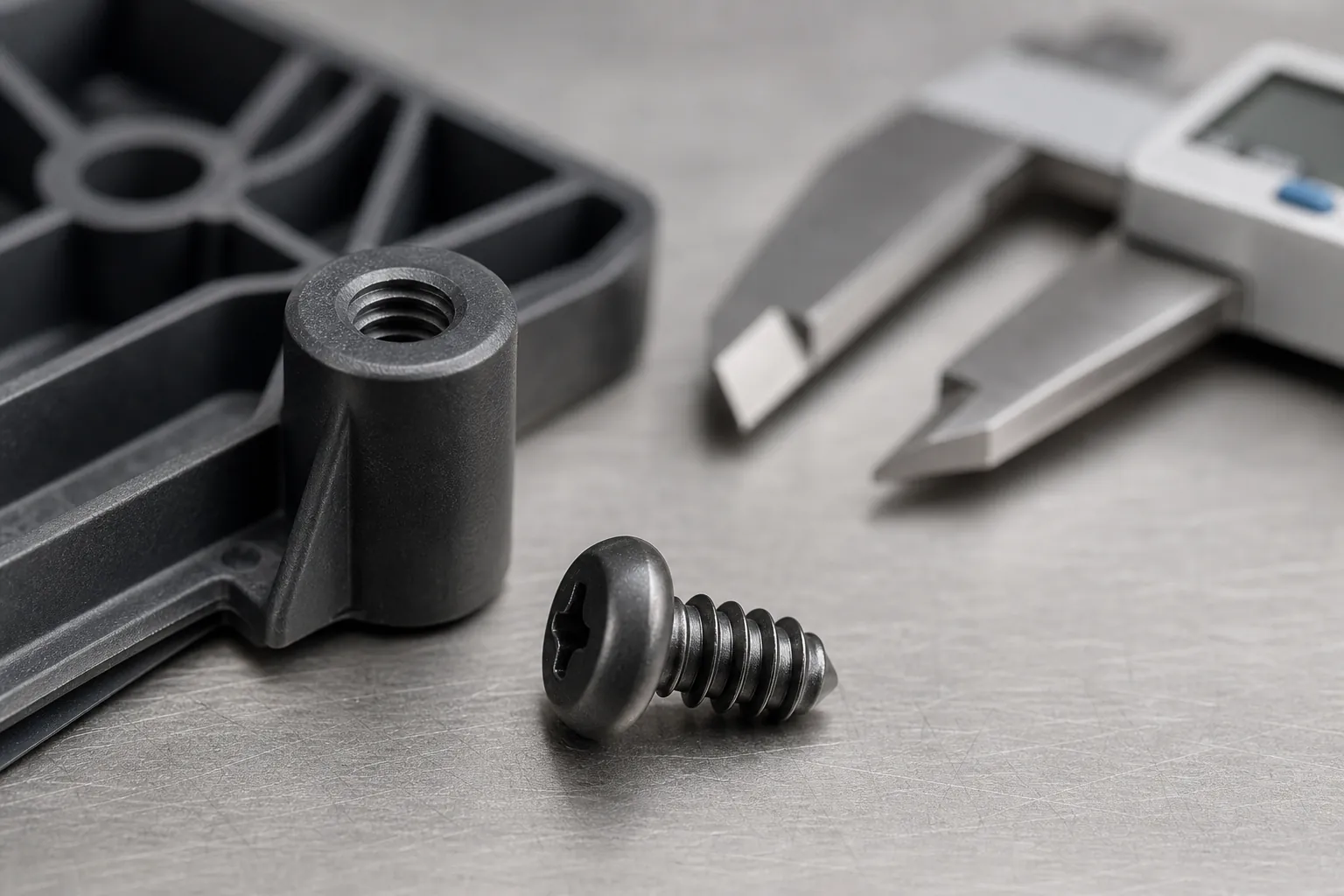
Thread-forming screws for plastic can eliminate a tapped hole, nut, or separate insert, but the screw alone does not determine whether the joint will work. The thread profile, molded pilot hole, boss wall, resin behavior, driver settings, and required clamp load act as one system. A screw that performs well in unfilled ABS may crack a glass-filled boss or strip a soft polymer when the same hole and torque are reused without validation.
This guide explains the decisions an engineer or buyer should resolve before specifying a plastic-assembly screw. It focuses on practical selection and RFQ information rather than treating one nominal screw size as a universal answer.
How a thread-forming screw works in plastic
A thread-forming screw displaces the polymer around its flanks as it enters a molded or drilled pilot hole. It forms a mating thread without producing the same type of chip associated with a cutting fastener. Plastic-specific designs commonly use coarse spacing, a narrow flank angle, a lobed body, or a combination of these features to improve material flow and reduce the radial load placed on the boss.
The distinction matters because a standard machine screw is intended for a preformed internal thread, while a general-purpose self-tapping screw may create excessive wedge stress in a plastic boss. The correct thread-forming design should generate enough material engagement for pull-out and strip resistance without demanding a driving torque that damages the part.
Start with the plastic, not the screw catalog
Resin properties control how the material flows during installation and how the joint behaves later. Identify the exact grade where possible, including glass or mineral fill, rather than specifying only “plastic.” Thermoplastics such as ABS, polycarbonate, nylon, acetal, and polypropylene do not respond identically. Fillers can increase stiffness while reducing the strain the boss can tolerate before cracking.
- Soft or ductile resin: may accept deeper forming but can creep under sustained clamp load.
- Stiff or filled resin: can provide strong engagement but may need more conservative boss stress and tighter process control.
- Hygroscopic resin: can change dimension and mechanical behavior with conditioning.
- Brittle or cosmetic component: may require extra attention to entry geometry, head seating, and installation speed.
Operating temperature, chemicals, vibration, outdoor exposure, and expected product life also influence material and finish decisions. These conditions belong in the RFQ because a joint validated at room temperature may not retain the same clamp load in service.
Match thread geometry to the assembly risk
Plastic-fastening catalogs commonly use 30-degree and 60-degree thread forms, trilobular bodies, and proprietary profiles. Those labels are useful starting points, not interchangeable guarantees. A narrower flank angle can reduce radial stress and increase thread depth in some thermoplastics, while another geometry may be selected for a harder resin, a specific installation window, or licensed production requirements.
| Selection factor | Question to resolve | Failure if ignored |
|---|---|---|
| Thread profile | Is it intended for the actual plastic family and boss design? | Boss splitting, high drive torque, or weak engagement |
| Pitch and engagement | Is enough polymer captured without excessive displacement? | Pull-out or strip failure |
| Body form | Does the design reduce forming torque and support material flow? | Narrow assembly window |
| Head and bearing area | Can the joint seat without crushing or marking the component? | Surface damage or lost clamp load |
| Drive style | Can production equipment transmit torque without cam-out? | Damaged recesses and unstable seating |
Trademarked profiles should be named accurately when a drawing requires them. If the requirement is performance-based, define the resin, geometry, torque window, pull-out target, and validation method instead of using a brand-style term as a vague synonym for every plastic screw.
Pilot-hole and boss design determine the installation window
The molded pilot hole must allow the screw to form a stable thread while leaving enough boss wall to contain radial stress. There is no responsible universal hole diameter for all resins and screw profiles. Begin with the fastener supplier’s recommendation, then account for molding shrinkage, draft, core-pin tolerance, material conditioning, and the actual screw lot.
A small entry chamfer or counterbore can help the screw start without lifting or cracking the boss edge. The available engagement length must also be reviewed: too little engagement limits holding strength, while adding depth beyond the useful thread length may only increase drive time and risk bottoming. Blind holes need clearance for the screw end and any displaced material.
Boss outside diameter, rib support, proximity to a wall, weld lines, and sink-mark limits are part-design decisions, not details the screw supplier can solve in isolation. Review the boss section in the assembled load path. A thick boss may create molding defects, while a thin unsupported boss may split before the desired clamp load is reached.
Control driving torque, seating, and stripping margin
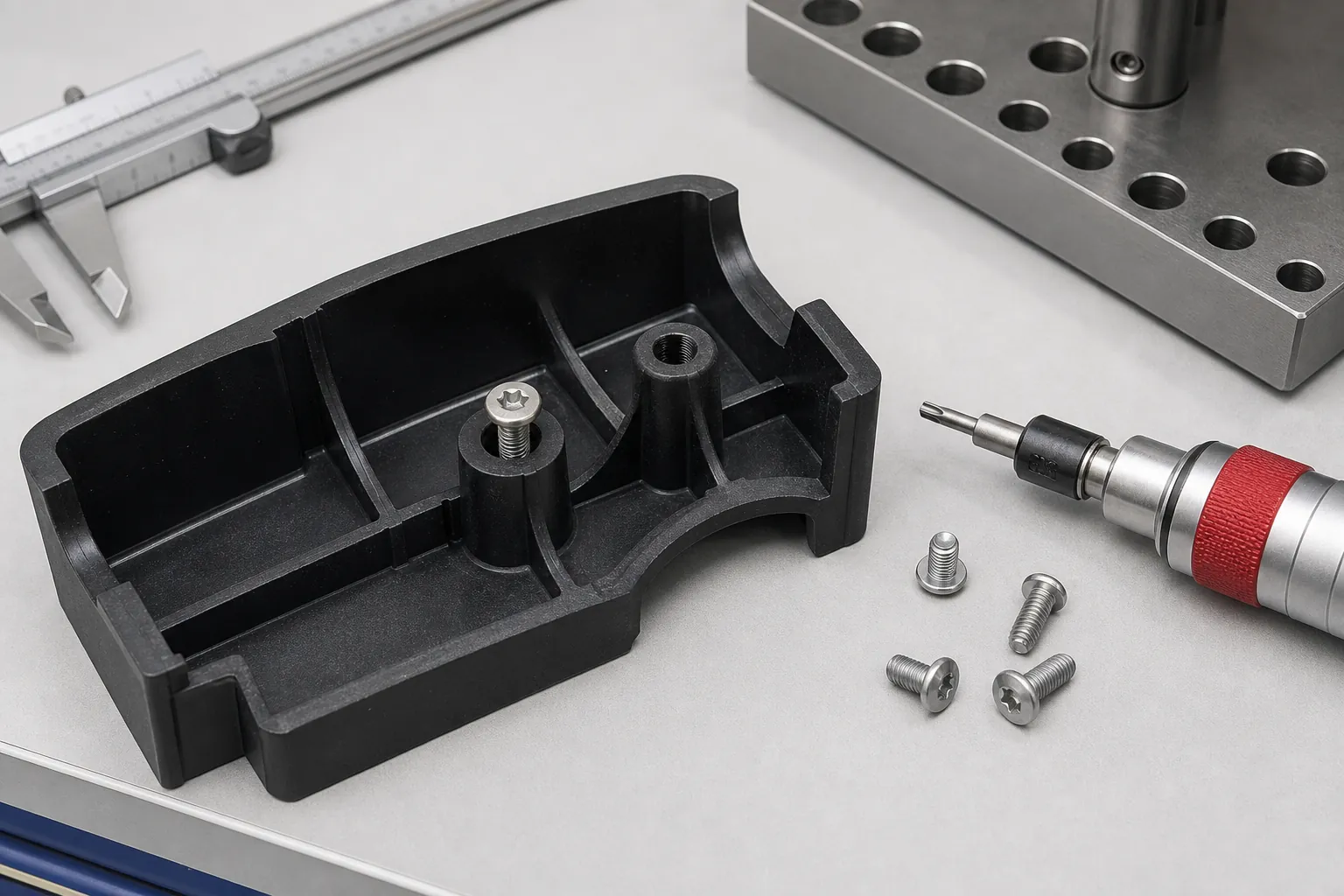
Production assembly needs a clear difference between the torque required to form the thread and the torque that strips the plastic. The usable driver setting must seat the head and establish clamp load without approaching the damage threshold. Do not copy a torque value from another resin, pilot hole, screw coating, driver speed, or boss condition.
- Measure driving torque through the full insertion cycle, not only the final peak.
- Record seating and strip torque on production-representative parts.
- Check how driver speed, bit alignment, and axial load change the result.
- Test at material and dimensional limits, not only at nominal conditions.
- Inspect for boss whitening, cracking, head embedment, cam-out, and incomplete seating.
For automated assembly, torque monitoring can reveal cross-threading, missing parts, blocked holes, or early seating. The acceptance window should be derived from trials rather than selected solely from the driver specification.
Plan for reassembly, creep, and service loads
A formed plastic thread may not tolerate unlimited removal and reinsertion. Reassembly can cut a new path, enlarge the existing thread, or reduce the torque margin. If the product will be serviced, define the expected cycle count and test it. A metal threaded insert may be more appropriate when repeated access, high clamp load, or field repair is central to the design.
Plastic can also relax under sustained load. Joint performance should therefore be checked after environmental conditioning, temperature exposure, vibration, or aging that represents the application. A satisfactory initial torque reading is not proof of long-term clamp retention.
What to send with a custom screw RFQ
A useful RFQ gives the manufacturer enough context to review manufacturability and propose a validation path. Send a section drawing of the plastic boss and the complete screw envelope rather than only a nominal diameter and length.
- Plastic resin and grade, including filler and conditioning where relevant.
- Pilot-hole diameter, depth, draft, entry feature, boss outside diameter, and nearby ribs or walls.
- Required screw length, head style, drive, material, finish, and cosmetic limits.
- Target clamp load, pull-out or strip requirement, driver speed, and installation orientation.
- Expected reassembly cycles, vibration, temperature, corrosion, and service life.
- Prototype and production quantities, inspection plan, packaging, and approval samples.
XiYu Precision reviews drawing-based requirements for custom precision fasteners. Buyers can also review the custom screw catalog and factory capabilities before sending boss drawings, samples, and target quantities.
Frequently asked questions
What is the difference between a thread-forming screw and a standard self-tapping screw for plastic?
A plastic-specific thread-forming screw displaces material to create a mating thread, normally using a wider pitch and a thread profile intended to limit radial stress. A generic sharp self-tapper may cut or wedge the plastic more aggressively. The correct choice depends on the resin, boss geometry, joint load, service life, and whether the assembly will be opened repeatedly.
How should a pilot hole be sized for a thread-forming screw in plastic?
Use the screw supplier’s starting recommendation for the actual screw series and resin, then validate it in production-representative molded parts. A hole that is too small can raise driving torque or split the boss, while an oversized hole can reduce thread engagement and strip-out resistance. Draft angle, molding variation, fillers, and material conditioning also affect the final diameter.
Can thread-forming screws be reused in a plastic boss?
Limited reassembly may be possible, but each cycle can alter the formed plastic thread and reduce the margin between seating and stripping torque. If routine service is expected, test the required cycle count or consider a metal insert. During reassembly, align the screw with the existing thread path before applying final torque.
What information should be included in an RFQ for custom plastic-assembly screws?
Send the resin grade, molded pilot-hole and boss dimensions, screw envelope, head and drive requirements, target clamp load, assembly speed, expected reuse, finish, order quantity, and any corrosion or cosmetic constraints. Samples, section drawings, and torque or pull-out targets help the manufacturer review the thread geometry and validation plan.
Choose the joint system, then validate the screw
Thread-forming screws for plastic work best when the screw geometry, polymer, boss, driver, and service conditions are specified together. Start from a suitable plastic-fastening profile, establish the pilot-hole and torque window with representative parts, and test the failure modes that matter to the product. That process produces a more reliable specification than selecting a screw by diameter alone.