
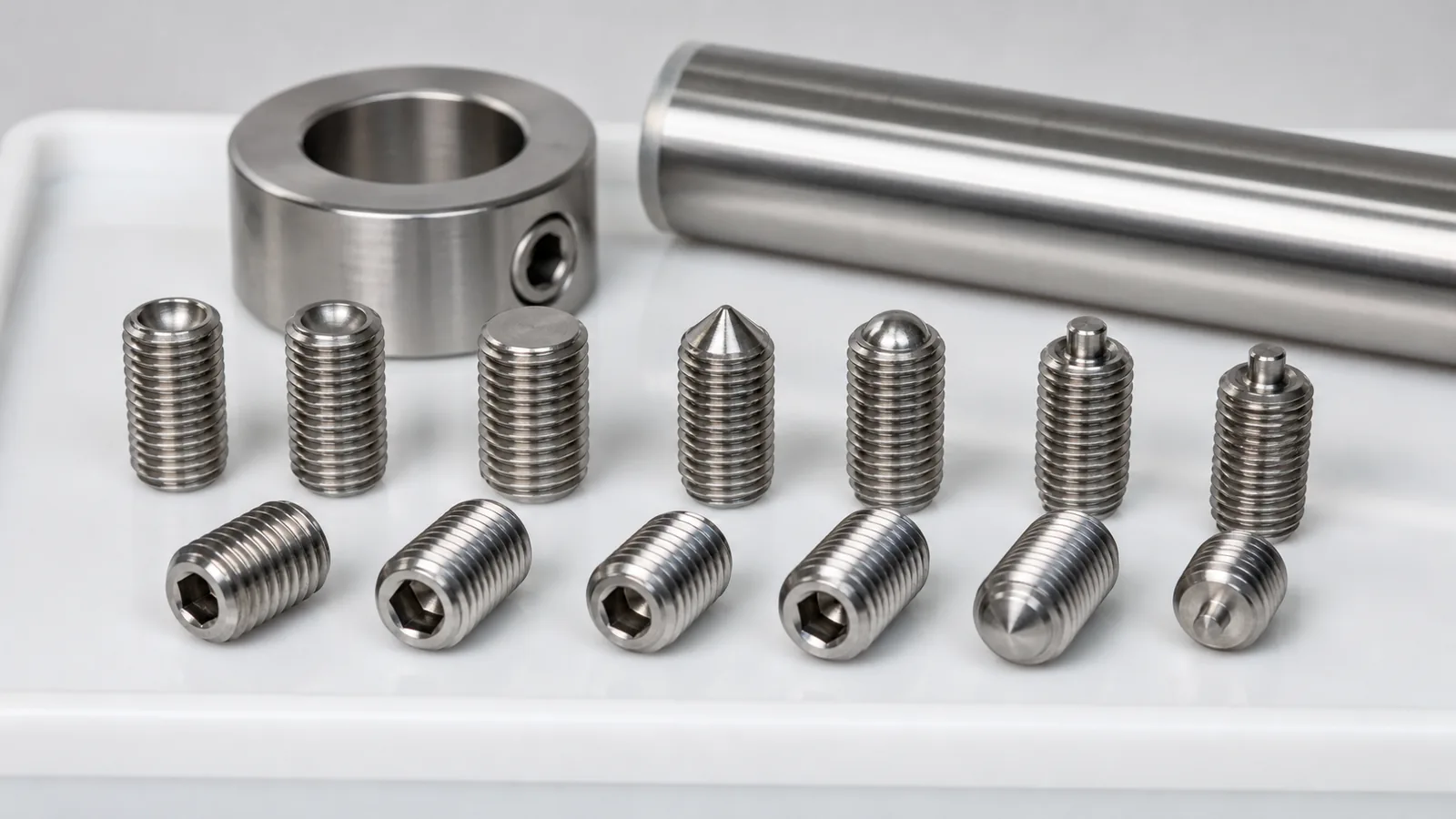
A stainless steel set screw can lock a collar, pulley, knob, or adjustment feature without adding a protruding head. It can also seize in the tapped hole, scar the shaft, slip under load, or become impossible to remove when point style and installation conditions are treated as catalog details. Corrosion resistance alone does not make the joint reliable.
This guide focuses on the decisions that affect holding behavior: point geometry, mating surface, stainless grade, galling control, drive engagement, and the information needed for a custom set screw RFQ.
First confirm what set screw means
In North American engineering usage, a set screw commonly means a headless, fully threaded fastener that presses its point against a shaft or enters a prepared feature. It is also called a grub screw. In some UK catalog usage, set screw may refer to a fully threaded hex-head fastener. That terminology conflict makes a drawing, standard, or product image essential for international purchasing.
A socket set screw normally has an internal hex drive at one end and a functional point at the other. The point does more than finish the part: it controls contact area, shaft marking, resistance to axial or rotational movement, and the ability to reposition the assembly. Selecting stainless steel before selecting the point reverses the correct order.
Select the point style from the mating surface
A cup point uses a circular edge to bite into the shaft and is a common general-purpose choice where some marking is acceptable. A cone point concentrates contact and can locate in a prepared conical seat for a more permanent position. A flat point spreads force and limits marking, making it suitable for adjustment or softer surfaces when lower bite is acceptable.
An oval point provides rounded contact for repeated adjustment or contact against a curved or angled surface. A dog or half-dog point enters a matching hole or slot and acts more like a locating feature than a friction-only contact. Nylon or other soft tips protect sensitive surfaces but change temperature, chemical, and holding behavior. No point style is strongest in every joint.
- Use cup point when dependable bite is needed and a ring mark on the shaft is acceptable.
- Use cone point with a prepared seat when precise, permanent location and axial resistance are priorities.
- Use flat or oval point when adjustment and reduced surface damage matter more than maximum bite.
- Use dog point when the mating part provides a hole or slot that positively locates the screw.
- Use a soft tip only after checking creep, temperature, chemicals, and required holding force.
Holding power depends on the shaft and contact feature
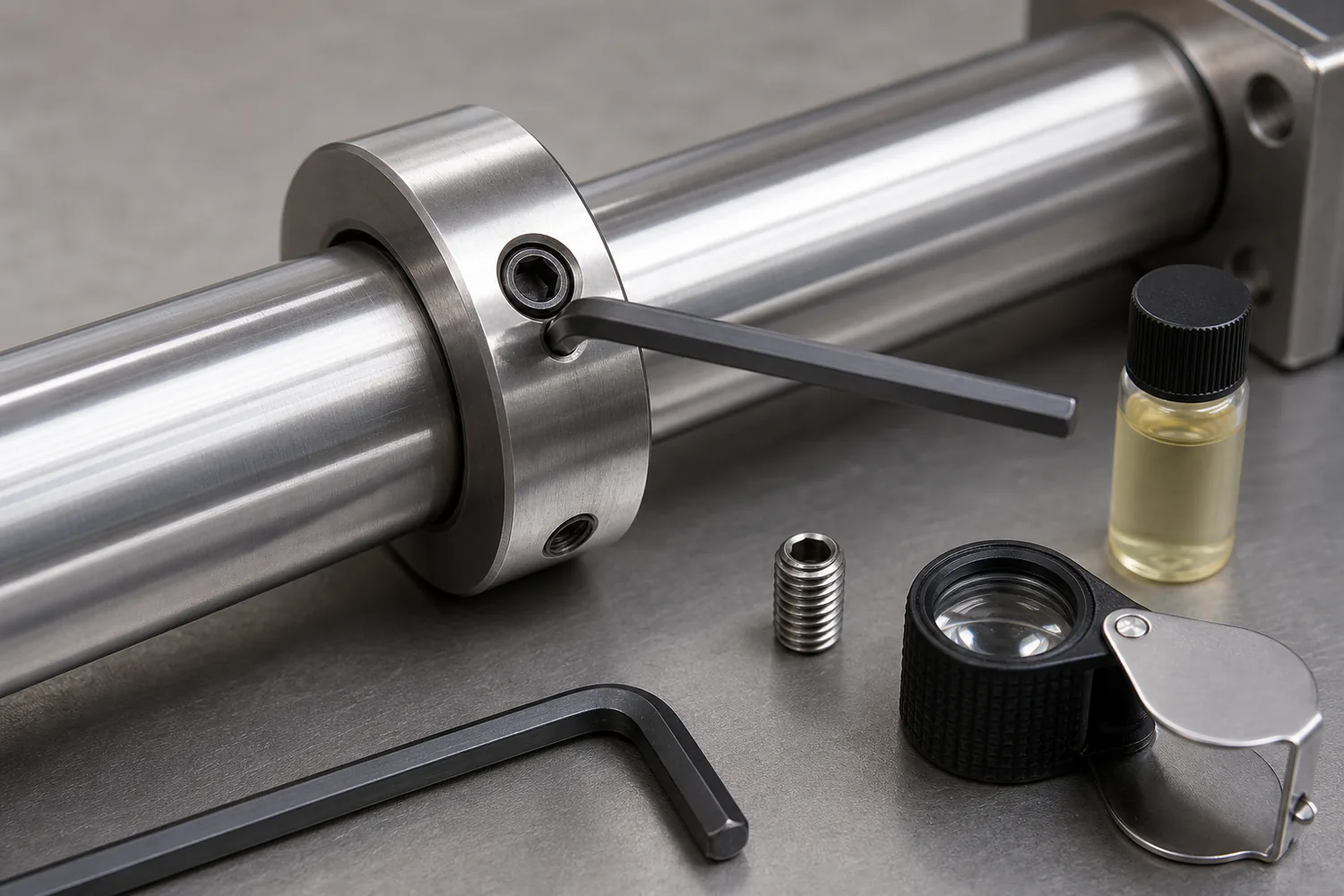
The same set screw can perform very differently against a hardened shaft, soft aluminum, a ground flat, or a drilled seat. A hard smooth shaft may resist penetration by a cup point, while a soft shaft may be damaged before the desired holding force is reached. A prepared flat improves seating repeatability and can reduce raised burrs that complicate disassembly. A dimple or hole can support a cone or dog point when location is important.
Torque is only an input to the contact. The resulting holding capacity depends on thread friction, point geometry, shaft hardness, surface finish, contact radius, collar stiffness, and applied axial or torsional load. Validate the joint under the actual vibration, reversal, impact, and temperature conditions. For critical torque transmission, a key, spline, clamp hub, pin, or another positive feature may be more appropriate than relying on one set screw.
Choose the stainless grade for exposure and strength
A2 and 18-8 stainless descriptions commonly indicate general-purpose austenitic stainless fasteners, while A4 or 316-type material is considered for more demanding chloride or chemical exposure. These labels should not be used as universal corrosion guarantees. Temperature, crevices, cleaning agents, galvanic couples, surface condition, and exposure duration determine whether a grade is suitable.
Mechanical behavior matters as well. Austenitic stainless cannot simply be treated as a direct replacement for hardened alloy-steel set screws when point penetration and high socket strength are required. Define the required material standard, property class or hardness, corrosion condition, and holding test. If a hardened point and high corrosion resistance are both necessary, the design may require a more specialized material or construction reviewed by the manufacturer.
Stainless threads need a galling plan
Galling is adhesive wear that can cause stainless mating threads to drag, transfer material, and seize during installation. Bossard’s technical guidance describes the role of friction and damage to the protective oxide layer, while PENCOM identifies practical contributors such as misalignment, high installation speed, rough or damaged threads, debris, and similar mating materials. Small set screws are particularly unforgiving because the internal socket offers limited removal margin once the threads bind.
Risk reduction may include clean undamaged threads, proper alignment, slower controlled installation, a compatible lubricant or supplier-applied anti-galling treatment, and a reviewed material pairing. Lubrication changes the torque-to-contact-force relationship, so an old dry torque value should not be retained without validation. Cleanliness-sensitive, vacuum, food, medical, or electronic applications also need an approved lubricant and contamination plan rather than an informal shop-floor addition.
Protect the internal socket during installation
The socket is the only practical removal interface on most headless set screws. Use the exact bit size, fully engage it, keep it aligned, and avoid ball-end keys for final high torque unless the tool and application specifically permit them. Worn bits concentrate contact at the socket corners. Debris, plating, or an incompletely formed recess reduces engagement before assembly begins.
A short set screw may have limited space between the socket bottom and the point geometry. Increasing recess depth can weaken the point end or break through a custom feature. When torque, length, and point shape conflict, the drawing must identify which function has priority. Prototype parts should be checked for both installation and removal after environmental exposure.
Control seating without crushing the point or shaft
A set screw does not create a conventional underhead clamp joint. Driver torque generates axial force through the threads, and the point transfers that force into a small contact region. Excess torque can deform the point, raise a burr on the shaft, strip the tapped hole, crack a thin hub, or damage the socket. Too little force allows micro-movement that can polish the contact and loosen the assembly.
Establish a process window with representative collars, shafts, tapped holes, lubrication, and fastener lots. Record installation torque and inspect the contact mark. Then test slip, pull, vibration, and removal as appropriate. If two set screws are used, their spacing and tightening sequence affect load sharing; doubling the screw count does not automatically double capacity.
Standards and custom dimensions must be stated clearly
Metric socket set screw families are commonly associated with separate standards for flat, cone, dog, and cup points. The applicable edition and any drawing deviations should be stated explicitly. Inch products use different dimensional references. Avoid combining a metric point-style name, an inch thread callout, and an informal material label without a controlling drawing.
Custom needs may include miniature threads, a special point length, a brass or nylon tip, a vent path, a locking element, a controlled breakaway feature, or an unusual material. These features affect forming, machining, heat treatment, cleaning, and inspection. Very short lengths can be difficult because the socket, thread, and point compete for the same small volume.
Inspection should follow the functional risks
Thread gauges and length are only the beginning. Check socket size, depth, fill, and damage; point angle, diameter, projection, concentricity, and finish; material and hardness; surface condition; locking element location; and cleanliness. For a dog point, diameter and projection control fit in the mating hole. For a cone point, angle and concentricity influence seating. For a cup point, rim form affects bite.
Application approval should include the mating parts. A set screw that passes its individual drawing may still fail because the tapped hole is oversized, the shaft hardness changed, the locating flat moved, or lubricant was omitted. Keep the fastener and assembly control plans connected.
What to include in a stainless steel set screw RFQ
- Identify the set screw or grub screw standard, thread system, size, pitch, tolerance, and overall length.
- Specify point style and all functional point dimensions, including any mating flat, seat, hole, or slot.
- Define stainless grade, property or hardness requirement, passivation or finish, corrosion exposure, and cleanliness.
- State socket size, installation and removal conditions, lubrication or locking element, target torque, and reuse.
- Provide shaft and hub materials, hardness, loads, vibration, temperature, test criteria, quantity, and inspection records.
XiYu Precision reviews drawings for custom precision fasteners and miniature threaded components. Review the manufacturing capabilities, custom screw catalog, and precision fastener applications before sending samples and load requirements. For galling background, consult the technical papers from Bossard and PENCOM.
Frequently asked questions
Which point style is best for a stainless steel set screw?
There is no universal best point. Cup points suit general holding where shaft marks are acceptable; flat and oval points reduce damage; cone points suit prepared seats and permanent location; dog points engage holes or slots for positive positioning.
Do stainless steel set screws gall?
They can. Risk increases with friction, similar stainless mating materials, high speed, misalignment, rough or damaged threads, and contamination. A validated combination of material pairing, clean threads, controlled speed, and compatible lubrication or treatment can reduce risk.
Can stainless set screws replace hardened alloy-steel set screws?
Not automatically. Stainless may provide better corrosion resistance but different hardness, point penetration, socket strength, and friction. Compare the mechanical and environmental requirements in the actual joint.
Should a set screw contact a shaft flat?
A prepared flat can improve seating repeatability, reduce raised burrs, and simplify removal. Cone and dog points may use purpose-made seats or holes. The correct feature depends on required holding, location, adjustability, and acceptable shaft damage.
Specify the contact, not just the stainless screw
Reliable stainless steel set screws come from matching the point to the shaft, selecting a grade for the real environment, protecting the socket, and controlling galling and installation. Put those decisions on the drawing and validate the complete hub-and-shaft assembly. That is more dependable than choosing a stainless catalog part and trying to correct slip or seizure with torque alone.