
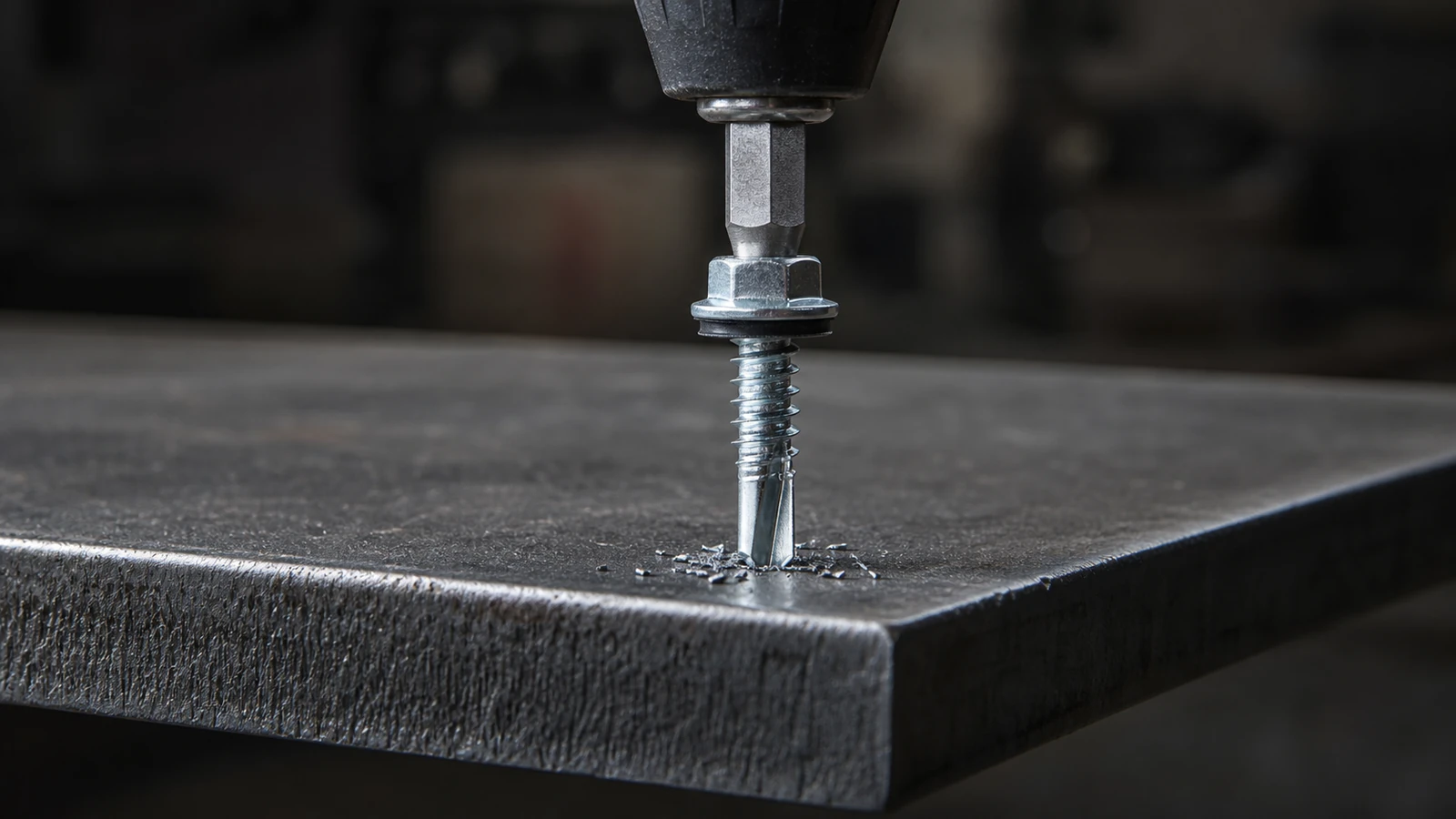
The wrong screw for thick steel rarely fails in the quote spreadsheet. It fails when the installer leans on the tool, the point burns before it cuts, the head cam-outs under seating load, or the joint closes only after the coating is already damaged. A search for self drilling screws for thick steel usually starts as a product hunt, but the real buying problem is matching drilling capacity to the actual steel stack without turning field installation into a guessing exercise.
This guide explains how to choose self drilling screws for thick steel, what the drill-point designation really changes, and which RFQ details matter before sampling or release.
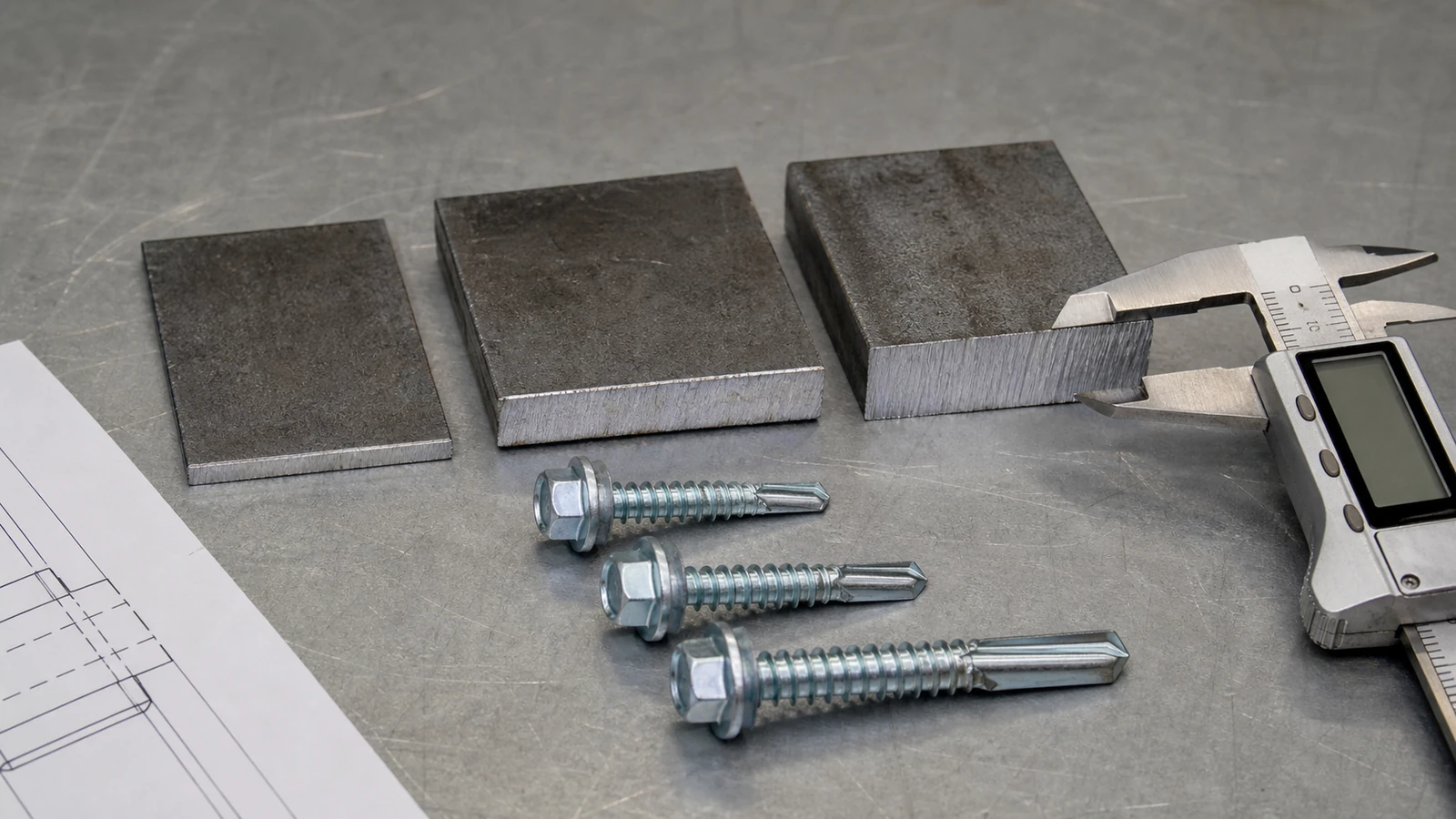
Why thick steel changes the selection logic
A screw that works in thin sheet can fail immediately in heavy-gauge steel because the point geometry, flute volume, and heat generated during drilling are different. Thick steel creates a longer cutting path, more chip load, and more opportunity for work hardening if the tool speed or pressure is wrong. That is why buyers should not treat self-drilling screws as a single interchangeable family.
For thick steel, the practical question is drilling capacity rather than catalog category. The common question is not simply whether the screw is self-drilling. It is whether the point and geometry are rated for the actual thickness stack in the job.
Start with drill-point capacity, not thread size alone
The most useful first filter is the drill-point range. Pages such as Tanner Bolt’s TEKS 5 overview and Value Fastener’s self-drilling guide both make the same practical point: heavier steel requires a longer and more aggressive point, and the capacity claim belongs to that exact screw family, not to all self-drillers with the same diameter.
In purchasing terms, diameter and length tell you very little until the point number is confirmed. A larger diameter screw with an inadequate point may still stall or overheat in thick steel. A properly matched point can drill faster, reduce installer force, and limit premature tip wear.
- Confirm the maximum combined steel thickness the selected point is rated to drill.
- Check whether the published capacity is steel-to-steel, steel-to-support, or a specific panel system.
- Do not copy point numbers across brands without verifying the actual product documentation.
Head style and drive matter more than buyers expect
Thick steel joints often need higher seating torque than thin-sheet work, which means head style and drive performance can become a failure point before the drill point is even proven. A countersunk head may look neat on paper but can be a poor choice when the joint face is thick, hard, or cosmetically sensitive. Hex washer heads, flange styles, or other broad-bearing designs often provide a safer installation window when clamp force is high.
Size tables do not establish installation stability. Buyers should ask whether the drive will remain reliable after chips form, whether the head spreads load without crushing coatings, and whether the access side allows the tool to stay square through the full drilling cycle.
Material and coating decisions still control field performance
A screw that can drill thick steel is not automatically the right screw for corrosion exposure, cosmetic faces, or long-term maintenance. Carbon steel with an appropriate coating can be the right answer for many structural or industrial joints, while stainless systems may be chosen where corrosion risk dominates. The selection has to balance drilling performance, galvanic pairing, finish durability, and service environment instead of defaulting to one material label.
In the RFQ, state whether the joint is indoor or outdoor, whether the fastener is exposed after installation, whether repainting is allowed, and whether burr formation on the exit side is acceptable. Those conditions change the recommendation more than a generic material preference does.
What to include in a thick-steel screw RFQ
A useful RFQ for self drilling screws for thick steel should describe the actual drilling job, not only the nominal screw size. Thick steel applications are sensitive to stacked tolerances, support conditions, access angle, and install speed. Without that context, the supplier can only guess from catalog families.
- State the full steel thickness stack, including coatings, gaps, and backing members.
- Specify whether the joint is steel-to-steel, steel-to-bracket, or steel-to-panel with insulation or air space.
- Call out head style, drive, required bearing surface, and any finished-face marking limits.
- Describe corrosion exposure, approved coating systems, and whether repainting or sealing occurs after installation.
- Include trial criteria such as drilling completion, seating quality, burr acceptance, and torque-window observations.
If the job is still early, the custom screw RFQ checklist, the custom screw catalog, and XiYu’s self-drilling and self-tapping screw page are the best internal references to align the drawing, sample request, and production questions before release.
Common mistakes when buyers test self-drilling screws for thick steel
The most common mistake is evaluating only whether the screw eventually went through. A slow, overheated, or unstable test can still look like success while hiding the real production problem. Another mistake is using one unusually easy sample stack and then assuming the same screw will perform on coated, misaligned, or harder heats of steel in production.
- Judging the screw by diameter and length while ignoring point geometry.
- Testing at one tool speed and assuming the same result will hold across the line.
- Skipping coating, finish, or burr checks because the focus stays only on penetration.
- Approving a screw without documenting the real steel thickness that was tested.
Frequently asked questions
How thick of steel can self-drilling screws handle?
It depends on the exact screw family and point designation. Thick-steel applications usually require a higher-capacity drill point, and the actual limit has to come from the product documentation for that screw, not from a generic self-drilling label.
Are TEK screws and self-drilling screws the same thing?
TEK is commonly used for a well-known self-drilling screw family, but buyers still need to confirm the specific point type, head style, coating, and documented capacity before treating one product as equivalent to another.
Can stainless self-drilling screws be used for thick steel?
Sometimes, but the decision depends on drilling capacity and corrosion needs together. Stainless can improve corrosion resistance, yet it still has to meet the real thick-steel drilling requirement for the job.
What is the most important RFQ detail for thick-steel screws?
The full steel thickness stack is usually the most important starting point because it determines whether the selected point geometry is even in the correct drilling-capacity range.
Choose the screw around the drilling job, not the catalog shortcut
Self drilling screws for thick steel can save major installation time when the point, head, coating, and joint conditions are matched correctly. They become unreliable when buyers treat thick steel as just another size variation. Start with the real thickness stack, verify the rated drilling capacity, and state the installation conditions clearly in the RFQ. That is how self drilling screws for thick steel become a controlled engineering choice instead of a field-install gamble.